
The joint statement issued after Prime Minister Narendra Modi and President Barack Obama's first-ever summit is high on intent and ambition. Notably missing from the statement is India's refusal to be America's partner in its war against ISIS.

The US has told India and other countries to cut oil imports from Iran to 'zero' by November 4 or face sanctions.

During the trip, Mukherjee will hold bilateral talks with Russian President Vladimir Putin on civil nuclear cooperation, defence ties and partnership in higher education.
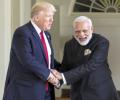
The camaraderie between Modi and Trump was on full display as the two leaders heaped praise on each other.
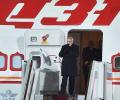
During his two day visit, Modi is expected to seal a raft of major deals in defence, nuclear energy and hydrocarbons sectors to further cement their 'special and privileged strategic ties'.

"Welcome to India, President @EmmanuelMacron! Your visit will add great strength to the strategic partnership between India and France. I look forward to our talks tomorrow," Modi tweeted after receiving Macron at the airport.

Although the pact would focus mainly on the Pacific and the South China Sea region, any action designed to deter China with or without New Delhi's active participation is a welcome move, notes Commodore Venugopal Menon (retd).

India and France on Monday inked an Inter-Governmental Agreement on the sale of 36 French fighter jets, Rafale, but were unable to sign the final deal due to some "financial" aspects, which are expected to be sorted out in "couple of days".

French President Francois Hollande indicated on Sunday that the nearly Rs 60,000 crore Rafale jets deal is unlikely to be signed during his current visit although it is on the "right track".
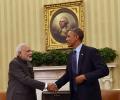
Furthering Indo-US cooperation on terrorism, Prime Minister Narendra Modi and President Barack Obama on Tuesday agreed to make "joint and concerted efforts" to dismantle safe havens for terror and criminal networks like Lashkar-e-Tayib, Jaish-e-Mohammad, Dawood-company, Al Qaeda and the Haqqani network.

In perhaps the first major conference on the United States-India strategic partnership in the aftermath of the Khobragade controversy that plunged the bilateral relationship in a downward spiral and is now in the process of being resurrected, the undeniable consensus among the panelists and participants was that much ballyhooed strategic convergence between Washington and New Delhi has dissipated.
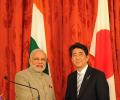
The "understanding" between India and Japan on civil nuclear issue has "improved", Prime Minister Narendra Modi said on Monday, after talks with his counterpart Shinzo Abe even as the much-anticipated remained deal remained elusive.

Prime Minister Manmohan Singh and United States President Barack Obama will meet in Washington on Thursday to chart a course for "future cooperation" in areas such as civil nuclear technology, trade, investment, defence and counter-terrorism, amid perceptions that bilateral strategic ties have plateaued.

Swaraj expressed satisfaction over the agenda of the inaugural dialogue while giving the details of the deliberations.

Moving ahead with their new mantra -- Chalein Saath Saath: Forward Together We Go -- Prime Minister Narendra Modi and United States President Barack Obama on Tuesday vowed to deepen cooperation in every sector for the benefit of global stability and people's livelihoods over the next ten years.
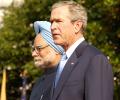
'If we could break through this symbolic barrier of sanctions and a dysfunctional relationship, we could do anything.'

Prime Minister Narendra Modi's opinion piece in Canada's The Globe and Mail focuses on commercial cooperation in the civil nuclear energy sector.

Prime Minister Manmohan Singh on Sunday arrived in Moscow on the first leg of a two-nation visit, during which he will hold talks with Russian President Vladimir Putin to strengthen bilateral strategic partnership.
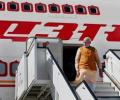
Prime Minister Narendra Modi will embark on a four-day trip to Japan from August 31 to bolster bilateral ties in key areas of civil nuclear cooperation, security, defence and trade.

India is expected to strongly push for a bilateral totalisation agreement with the US during President Barack Obama's visit later this month.

On the final day of Prime Minister Narendra Modi's visit to the US, that country on Tuesday extended its Defence Cooperation Agreement with India by another 10 years. The pact, which was to expire in June next year, will now be in force till 2025.

The beauty of the relationship between the two countries is that they agree to disagree and perhaps that is the strongest bond between the two governments and their relationships, notes Rup Narayan Das.
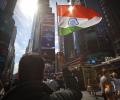
'We had to convince our people that we were doing nothing that would erode our strategic programme. We were all the time arguing that we are not doing anything, which will remotely impact on our strategic programme.'
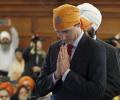
'The India-Canada relationship has suffered benign neglect. Its full potential has not yet been realised,' says Rup Narayan Das.

His remarks without naming any country came against the backdrop of tension between India and Pakistan after New Delhi revoked Jammu and Kashmir's special status.
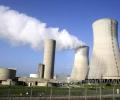
These reactors would bring clean energy to India and generate thousands of jobs in the US
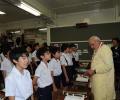
Prime Minister Narendra Modi on Monday visited the Taimei Elementary School in Tokyo ahead of the significant summit-level talks with his Japanese counterpart Shinzo Abe.
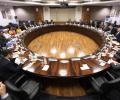
'India appears to have stood its ground on strategic autonomy by resisting US pressure on Russia, China and Iran, but succumbed to the temptation to walk into a tighter embrace in defence cooperation, a high priority of the Trump administration,' notes Ambassador T P Sreenivasan.

Leaders at the G20 summit on Wednesday called for an immediate end to the Ukraine conflict, holding that "today's era must not be of war", a formulation that echoed Prime Minister Narendra Modi's message to Russian President Vladimir Putin in September.

Russia is a strong and reliable friend of India and both countries have a "truly strategic" partnership, PM Modi on Thursday told President Vladimir Putin.

Prime Minister Narendra Modi's three-day visit to Britain has seen India and the UK agreeing on Rs 90,000 crore deals.

Macron held a tete-a-tete with Modi before the delegation-level talks at the Elysee Palace - the official residence of the French president.

Prime Minister Narendra Modi on Saturday announced the adoption of the New Delhi Leaders Declaration, a significant victory for India's G20 presidency that came amid increasing tensions and divergent views over the Ukraine conflict.
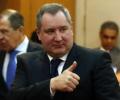
Dmitry Rogozin, deputy prime minister of Russia, in an exclusive conversation with rediff.com's Sheela Bhatt says, what Russia can do and has done for India nobody can do.
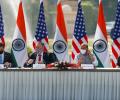
Henry Kissinger once said, 'It may be dangerous to be America's enemy, but to be America's friend is fatal.' India will have to wait and see, observes Rajeev Srinivasan.

Here is the full text of the joint statement issued by India and the US.

Modi said Kudankulum 1, an Indo-Russian project, was an important addition to the continuing efforts to scale up production of clean energy in India.

'The United States should not, by this logic, expect India to create military distractions along the Line of Actual Control, hold up Chinese shipping in the Indian Ocean, or even openly provide intelligence or basing for US forces transiting the region.'

Jaishankar also met his Iranian counterpart H Amirabdollahian and held productive discussions on bilateral economic cooperation, Afghanistan and the joint comprehensive plan of action, also known as the Iran nuclear deal.

The Australian prime minister also said that he briefed Prime Minister Modi on AUKUS - a trilateral security arrangement between Australia, the UK and the United States that was unveiled in September 2021.
